
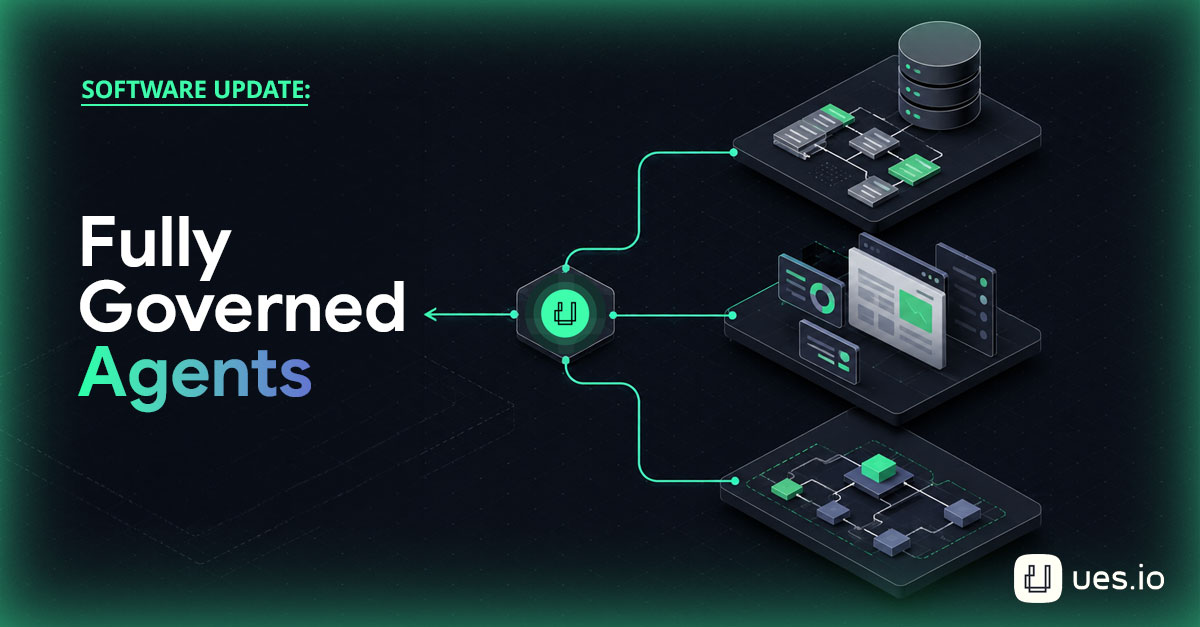
Zurich, Switzerland — UESIO, the AI-native platform for building enterprise applications and agents, today announced the general availability of three agent-driven capabilities: the View Builder agent, the Schema Builder agent, and the App Builder agent. Each brings more of the app-development process inside UESIO’s governed, sovereign runtime. Working through natural-language conversation, the agents let enterprise teams generate, modify, and validate every layer of an application — its user interface, its data model, and complete end-to-end scaffolding. Crucially, the agents write directly into UESIO’s declarative YAML layer rather than a black box. Every change they make is transparent, inspectable, and version-controlled, so teams get the speed of AI-generated applications without giving up control over what was built.
Agents that build inside the platform, not around it
Most “AI app builders” bolt a chat window onto an existing tool. UESIO’s approach is different: each of these agents operates as a first-class citizen of the platform’s metadata model, reading and writing the same YAML that a developer would hand-edit.
Schema Builder agent — Builds and modifies collections, fields, and relationships from natural-language instructions, then saves directly through the platform’s schema API. It’s the same data-modeling layer developers use, just exposed conversationally, with each proposed change subject to the platform’s normal validation rules.
View Builder agent — Generates and edits view YAML: wires, components, layouts, and merge logic. It understands UESIO’s own component catalog and layout conventions, so generated views inherit an app’s existing design system instead of drifting from it. Built-in guardrails validate generated views before they ever reach preview — catching issues like malformed merge expressions or incomplete layouts so every view the agent produces is render-ready.
App Builder agent — Coordinates the two above into a single build flow: describe the app, and the agent scaffolds collections, sample data, navigation and views together, keeping the builder in one continuous conversation rather than bouncing between screens.
“The point isn’t that an agent can produce a screen,”
said Gregg Baxter, CEO of UESIO. “It’s that the screen it produces is the same governed, auditable artifact a senior engineer would have written by hand — same schema rules, same component contracts, same deployment path. That’s the difference between a prototype and a production ready platform.”
Built for teams who can’t hand data to someone else’s model
All three agents run inside UESIO’s existing trust boundary: self-hosted or air-gapped deployment, tenant isolation, and full audit trails on every change an agent makes. For regulated industries — financial services, insurance, public sector — that means agentic development doesn’t require a new exception to the governance policy. It’s covered by the same one.
What’s next: orchestrating agents, not just invoking them
Today’s release covers agents that build applications. UESIO’s engineering team is now working on the next layer: multi-agent orchestration, allowing app builders to coordinate multiple purpose-built agents — an orchestrator with deterministic, declarative logic directing specialized sub-agents — within a single workspace, invocable directly from app logic.
Where today’s agents each handle one job well, orchestration is about composing several of them into a coordinated workflow — the architectural step that turns individual AI-assisted actions into governed, repeatable agentic processes.
This capability is in active development. UESIO will share timing and scope details as the work progresses.
UESIO is an AI-native enterprise application and agent platform built for data sovereignty, self-hosting, and governed, model-agnostic deployment.