
Audience: CIOs, CTOs, Chief AI Officers, and platform engineering leaders evaluating how to scale AI adoption without losing control of it.
Why humans belong in the loop, not in the weeds.
Every enterprise now has agents. A sales team has one drafting outreach. Finance has one reconciling invoices. IT has one triaging tickets. Each was procured separately, licensed separately, and governed — if at all — separately.
This is the same sprawl enterprises spent the last decade trying to escape with SaaS, except faster and with fewer guardrails. The question CIOs are now asking isn’t “which agent should we buy next?” It’s “how do we run all of this as one accountable system, on infrastructure we control?”
That’s an orchestration problem, not a tooling problem. And it’s the one that determines whether AI becomes a durable capability or a compliance liability.
Two kinds of agents, one governed system
Most conversations about “agentic AI” flatten a real architectural distinction. In practice, enterprises need two categories of agents working together:
Autonomous agents run continuously against a defined mandate — monitoring a claims queue, reconciling transactions overnight, watching for anomalies in a trading system. They act without a human initiating each step, but inside boundaries a human set and can audit at any time.
Single-task agents sit dormant until called. A relationship manager pulls one up to draft a client summary. An underwriter invokes one to check a policy against current regulation. They’re precise, scoped, and disposable — built for one job, not general-purpose conversation.
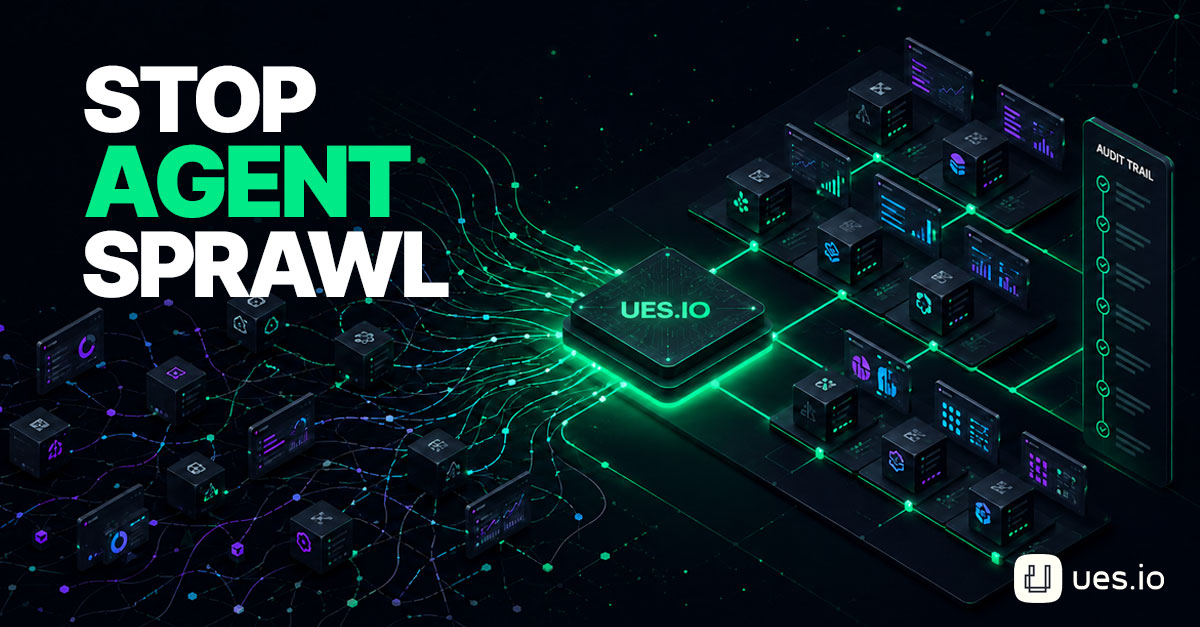
The mistake enterprises make is treating these as separate initiatives, each with its own tooling, its own logs, its own risk posture. They aren’t separate. They’re two modes of the same underlying system, and they need to be orchestrated — with shared identity, shared audit trails, and shared policy — by a platform built for that, not stitched together after the fact through point integrations.
This is what MCP-native orchestration is for: a common protocol that lets autonomous and single-task agents call the same governed tools, respect the same data boundaries, and leave the same audit trail, regardless of which model or vendor sits behind them.
Where the human actually belongs
“Human in the loop” gets used as a reassurance rather than a design principle. The real question is: in the loop where?
Not in the loop for the mundane. Nobody needs a human confirming that an invoice matched its purchase order, or that a support ticket got routed to the right queue. That’s exactly the work agents should absorb — the volume, the repetition, the 2 a.m. shifts.
The human belongs at the points that actually require judgment: the exception the model flags as ambiguous, the decision with regulatory or reputational weight, the moment a client relationship needs a person, not a policy. Well-designed orchestration doesn’t remove the human — it moves them to where their judgment is worth something, and gets everything else out of their way.
That only works if the system can reliably tell the difference — if it’s auditable enough that “the agent decided” is never an acceptable answer to “why did this happen,” and governed enough that escalation to a human is a designed behavior, not a fallback when something breaks.
What this looks like in practice
A wealth management firm processing a client’s estate transfer doesn’t need a single mega-agent attempting the whole workflow end to end. It needs:
- An autonomous agent monitoring the case queue, tracking document completeness, and flagging stalled steps — running continuously, no human trigger required.
- A single-task agent, called by the relationship manager, that drafts the client communication once the documents are verified — invoked once, for one job, then done.
- A human — the relationship manager — reviewing and sending that communication, because a client relationship in a six-figure transfer is not the place to remove a person.
Every one of those steps happened on infrastructure the firm controls, under one governance model, with one audit trail — not three vendor dashboards and three sets of access logs that don’t talk to each other.
That’s the difference between “we bought some agents” and “we run an agentic operation.”
Why this is an architecture decision, not a feature decision
The instinct is to evaluate agents one use case at a time: a claims agent here, a support agent there. Each purchase looks reasonable in isolation. Add them up over eighteen months and the enterprise has thirty licenses, thirty data-sharing agreements, and no single view of what any of it actually did.
The alternative isn’t fewer agents. It’s one platform that governs all of them — where autonomous and single-task agents alike run on infrastructure you own, orchestrate through a common protocol, and produce a single, auditable record of what happened and why. Not a layer bolted on after the fact to make separately-procured tools look coordinated, but the foundation the agents are built on from the start.
That’s the platform decision underneath the agent decision. Get it right, and every future agent — autonomous or single-task, built in-house or by a vendor — inherits the governance instead of adding to the sprawl.
Govern Everything. Lock In Nothing.
UESIO is the sovereign, MCP-native platform for building and orchestrating enterprise AI agents — autonomous and single-task alike — with governance, auditability, and infrastructure control built in from the ground up.